the three
THE QUESTION OF THE THREE IS ANCIENT.
It is not a number.
It is a threshold.
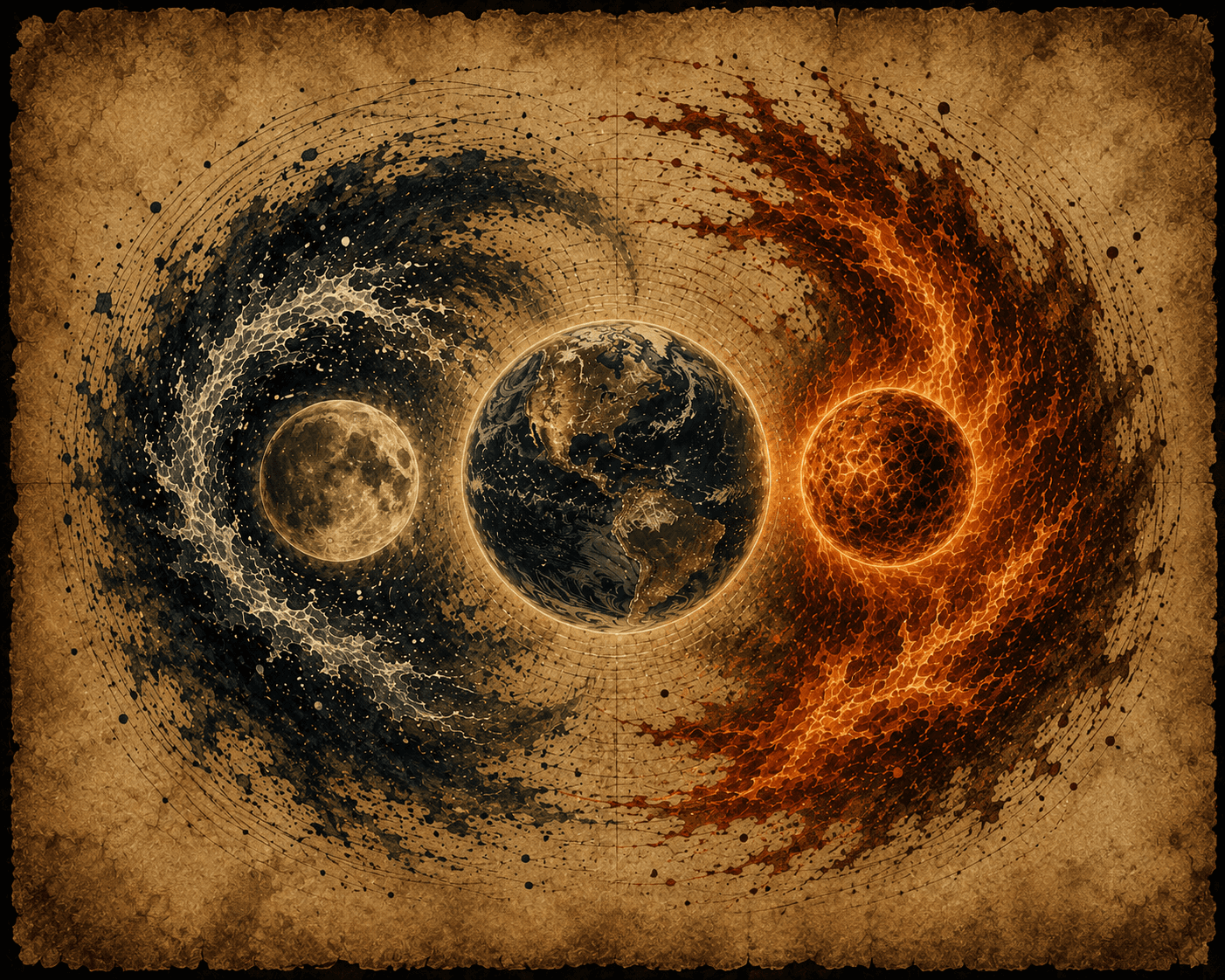
Across traditions that never intersected, across millennia and geographies and entirely different bodies of knowledge, the same structural recognition arrives: Two produces opposition. Four produces stable structure. Three produces something that neither opposition nor structure can produce alone. Three is the minimum configuration from which form can emerge. The generative threshold.
The Tao Te Ching states it without elaboration: one gives birth to two, two gives birth to three, three gives birth to the ten thousand things. Three is not the result of a process. Three is the point at which undifferentiated potential tips into the capacity to generate. What follows three is not more threeness. What follows three is the manifold — every living form, every specific expression, every singular event of becoming.
The Pythagoreans held three as the first complete number — the first to have beginning, middle, and end — and therefore the first capable of generating something beyond itself. One is unity. Two is division. Three is the first that can encompass and produce what it is not. The Neoplatonists articulated the procession: from the One, through Intellect, through Soul, to the world of form. Three movements — the third of which is the threshold of embodied reality.
The Vedic tradition names three qualities of nature — the three gunas — whose interplay generates all manifest form. Before form, the gunas are in perfect equilibrium. Creation is the disturbance of that equilibrium. The three in tension is the pre-condition of becoming.
Paracelsus named three principles — Sulphur, Mercury, Salt — as the “tria prima” of alchemical reality: not three substances but three forces whose convergence produces the conditions for material form to arise and hold.
These traditions do not derive from one another. Their convergence is not borrowed. What they share is the recognition of a structural fact: three is where tension becomes generative. Two creates polarity. Three creates the possibility of resolution, overflow, and the birth of something new. The third is always what mediates the first two — and in mediating, generates.
———
Within the Toltec lineage of ancient Mexico, this recognition took a specific and remarkable form.
The seers of that tradition observed that most naguals — the leaders and transmitters of knowledge within the lineage — carry a four-compartment energetic configuration. Quadripartite. Stable, generative of continuation, built for building. The four-pronged nagual constructs lineages, trains warriors, passes knowledge across generations. The four is the architecture of sustained transmission.
But the tradition also named a different configuration. Appearing rarely, at cyclical intervals, a nagual whose configuration carries not four compartments but three. The three-pronged nagual. Not deficient. Not lesser. Structurally distinct, and serving a different function entirely.
The teaching is precise. The Toltec seers associated three with dynamism and renovation — ternary formations announce unexpected changes. The three-pronged configuration does not appear to continue the lineage. It appears when a lineage has run its course — as a cathartic action, serving the propagation of new quadripartite lineages. It seals what has been. It returns to the generative source. And from that return, new cycles of four-pronged building become possible. The task that follows is to open the knowledge — transmission beyond the closed lineage, available to anyone with the energy and the intent to receive it.
The three-pronged configuration is not rebellion against the lineage it seals. It is the innate motion of change itself. The movement by which what has been built returns to its source — so that the source remains alive, generative, capable of producing new form. The four-pronged builds. The three-pronged returns.
———
At the planetary scale: Moon, Sun, Earth. Three celestial bodies in specific gravitational and energetic relation, their configuration determining the conditions of life on the surface of this planet. Not abstraction. Not symbol. Observable, measurable, present.
The Moon’s gravitational field stabilises the Earth’s axial tilt and moves the planet’s waters — its tides, its currents, the rhythmic redistribution of the fluid systems that keep the planet alive.
The Sun’s electromagnetic radiation reaches into living tissue, activates the cellular structure of life, drives the metabolic processes that sustain every organism.
The Earth holds the stable gravitational and mineral ground in which the cooperation of Moon and Sun becomes generative — becomes life, becomes the manifold tapestry of biological expression. Earth is the stable and fertile ground. Earth is where force becomes life.
What characterises Moon and Sun at planetary scale is legible at the surface: gravitational pull, electromagnetic radiation. Earth is different. What characterises Earth operates beneath the surface. The interior of the planet generates immense heat, rising continuously to the surface. Two sources feed it: the radioactive decay of uranium, thorium, and potassium, and the primordial heat carried in the planet’s interior since its formation. This heat drives plate tectonics, volcanic activity, the building of mountains, and the generation of Earth’s magnetic field.
The Sun and the Earth share the same deep source — nuclear processes at the core. But they move in opposite directions. The Sun fuses, builds up, and radiates outward. The Earth transmutes, and generates inward. The Sun gives into space. The Earth builds the conditions of life within. What holds the matter of Earth together at the atomic level — the strong nuclear force — is the same force that, in the Sun, is released as light. In the Earth it holds. In the Sun it radiates.
Earth does not receive the forces of Moon and Sun and hold them passively. Earth generates — from its own interior, from processes rooted at the deepest level of matter — the dynamic, mineral-rich, magnetically shielded, thermally active ground in which the cooperation of the three forces becomes life. This is not metaphor. This is what Earth is.
At the elemental scale: Water, Fire, Earth. The same three forces named at the register where they are met as qualities — as the observable character of what each force does. Water sustains, flows, penetrates, circulates. Fire activates, heats, drives, radiates. Earth holds form, receives weight, grounds what would otherwise scatter. Three elements. The same cooperation, at another register of scale.
At the terrestrial scale: the same three forces present as every living organism on this planet — unfolding continuously, in real time, in every body at every moment. In SUIKIDO they are named SUI 水 Water — KI 氣 Energy — DO 道 Path; and met directly in the body through three practices: Bodywork Therapy, Kinetic Movement, Martial Art. SUIKIDO meets them here, in the living body, in direct practice. What constitutes the Earth constitutes the body. The same forces — gravitational and electromagnetic — present at both scales, at this moment. The body is the terrestrial scale inhabited from within.
The architecture is what was found in practice. Not designed. Found.
———
The traditions that formed SUIKIDO prepared the ground it stands on.
The formation of the discipline spans decades — classical Japanese martial art, classical East Asian bodywork, Vedic and Daoist movement science, professional dance. The traditions that prepared the ground are named without ambiguity. The vocabulary SUIKIDO uses — Hara, Kappō, Taijutsu, Sappō, the forces as Water and Fire and Earth — is the vocabulary the traditions developed because it is the vocabulary in which the body’s operation has been most precisely articulated.
In 2001, inherited forms were tested against what holds in the body under direct conditions. What held, stayed. What did not hold was set aside — not rejected, but recognised as having parted from its living ground. Forms had become exercise and mimicry. The practice had separated from the source that once animated it.
This is the motion the Toltec record names as the three-pronged function: not destruction of what was built, but the return to the source that built it. The four-pronged lineages of classical transmission had run their course in the specific forms that had been received. The forms were real. They had carried genuine knowledge. But the living ground beneath them had been covered. What remained was the architecture without the force.
What followed was a return to first principles. Not to a philosophy. Not to an idea of what practice should be. To the body itself — to the forces that operate in it, to the structural facts that hold regardless of what any tradition has said about them. The natural forces operate everywhere, in every body, continuously. They precede every tradition that articulated them. The traditions did not create the Hara or the three forces or the vital points. They saw them. They named them. They transmitted what they had seen.
The rattlesnake sheds its skin. This is biological fact. The body leaves the form it has outgrown. What emerges was already forming beneath the surface while the old structure was still in place. Change requires release. What stays bound cannot change. The snake does not rebel against the old skin. It grows past it. What the shedding produces is not the destruction of the snake. It is the snake, renewed.
The renewal is not the act of a will that decided to renew.
It is the innate motion of what is alive, continuing to be alive.
———
SUIKIDO did not choose the three-fold configuration.
The three practices, the three forces, the three classical knowledges of Kappō 活法, Taijutsu 體術, and Sappō 殺法 — these are not a design. They are what remained when decades of testing in the body set aside everything that did not hold. Three remained. Not four, not two, not five. Three. The configuration was discovered, not constructed.
What the research across traditions shows is that this configuration — specifically three, specifically in the relation of a sustaining force, an activating force, and a generative ground — is the most widely and independently recognised generative structure in the human record. From the Tao Te Ching to Pythagorean mathematics to Neoplatonic procession to Vedic cosmology to Toltec luminous-body architecture to classical alchemy — the same three-fold structure is named as the threshold from which form arises.
The Kamon of SUIKIDO holds this. Two forms move into each other inside a circle. One is the Moon — water-like, drawing. One is the Sun — fire-like, radiating. Both move. Both yield. They interpenetrate. The circle is Earth. It has weight. All three converge. The convergence is the generative principle — where the three meet, life becomes.
The Purification Lodge holds this in enacted form. Fire is held in the heated stone. Water meets fire as steam and fills the space. Earth holds the dome, the floor, the stone pit, the convergence. At new moons and full moons, at equinoxes and solstices — at the moments when Moon, Sun, and Earth are in their most direct and potent relation — the Lodge is held.
SUIKIDO itself carries the function the Toltec record names as three-pronged. It returns to the source the classical lineages drew from. It opens what the institutional forms had enclosed. It transmits not through a closed lineage but to anyone who comes with the body and the attention to meet what is here.
This is not a claim about importance. It is a recognition of structural position. The three-pronged configuration does not elevate itself above the four-pronged that built the lineages. It serves a different function in the same cycle. The cycle is undivided. The source is what generates both.
Three forces. One name. The discipline takes its name from the principles by which it works.
SUIKIDO 水氣道

