suikido and yoga
A Conversation on What Is and What Is Not
Questions from a practitioner of Yoga. Answers from SUIKIDO.
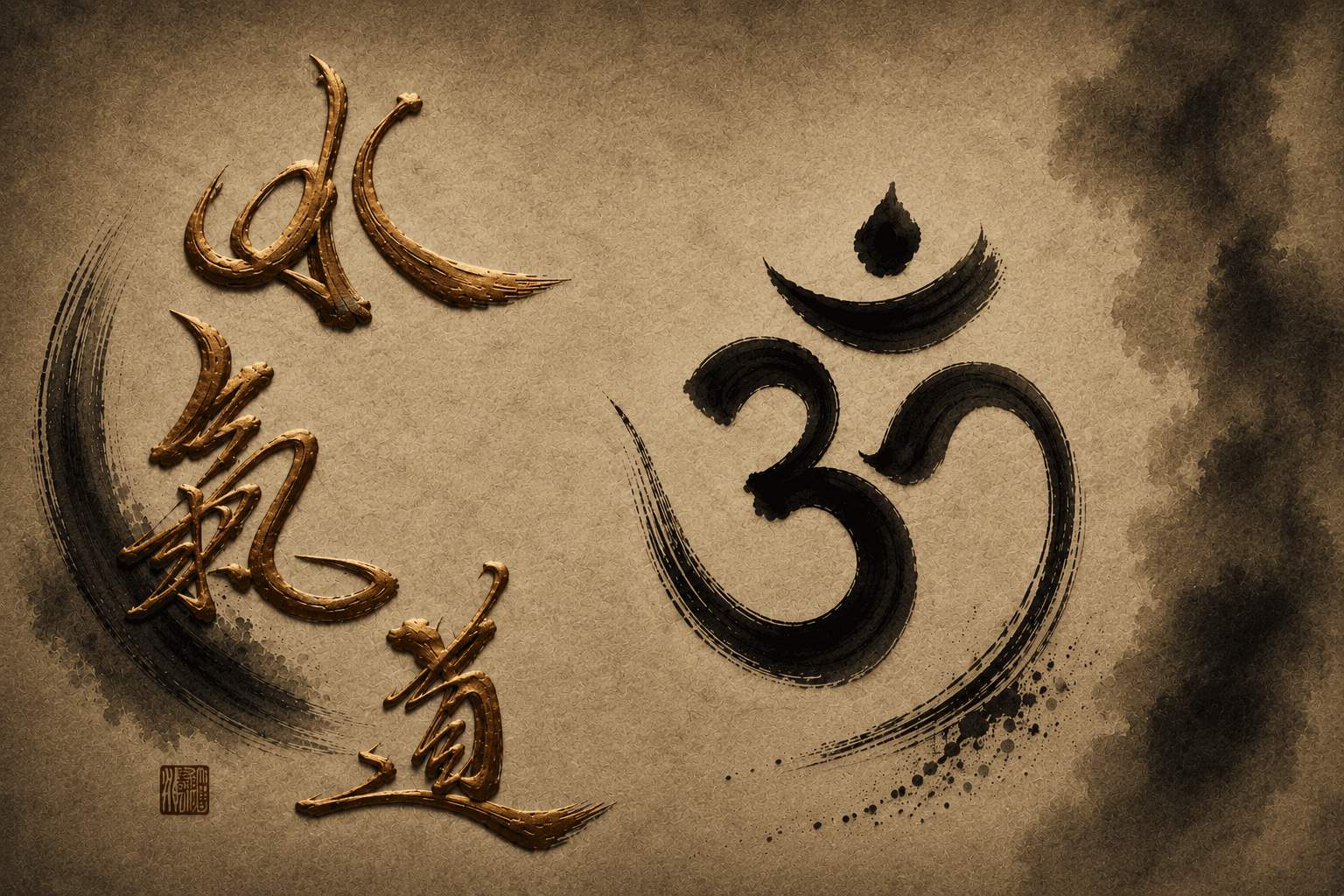
Is SUIKIDO a form of Yoga?
No. SUIKIDO is not a form of Yoga, not a derivative of Yoga, and not a practice that shares its foundation with Yoga. The resemblance some perceive is superficial — it arises from the fact that both practices involve the body and sustained discipline. Beyond that, the two begin from different premises, move in different directions, and operate according to different principles.
———
Where does the difference begin?
At the starting point. Yoga begins from the position that the human being is consciousness inhabiting a material body. The body is real but secondary. It is the vehicle through which consciousness acts, and the aim of practice is to refine, purify, and ultimately liberate consciousness from its entanglement with material existence. The ancient texts are explicit: the physical world is either illusion, or a lower order of reality, or a field of suffering from which the practitioner seeks release.
SUIKIDO begins from the position that the human being is a natural animal. The body is not a vehicle for something else — it is Life in the specific form of a human. What operates in the body — structurally, energetically, functionally — are natural forces. The forces, the body, and Life itself are not separate from each other. In the human, it all meets in the body.
———
Yoga also works with the body. Many traditions honour the body as sacred. Is the difference really that fundamental?
Even in the most body-positive traditions of Yoga — Haṭha (forceful yoga), Tantra (body-centred tradition), the martial discipline of Kalaripayattu — the body is still a means. A sacred means, perhaps, but a means. The postures prepare the body. The breath refines the body. The senses are withdrawn from the body. Each stage serves a transpersonal aim. The physical work exists so that consciousness can move past it.
In SUIKIDO, practice is contact with what is alive in the body. The forces that operate here are met here — directly, physically, in the body itself. What the practitioner meets is present and in motion. Practice does not aim elsewhere. It meets what is here.
———
Classical Yoga describes the practitioner’s relationship to nature — Prakṛti (nature) — as something to be transcended. How does SUIKIDO relate to nature?
In the Vedic framework, nature — Prakṛti — is the field of bondage. It operates mechanically through the three Guṇas (three qualities of nature). The practitioner’s task is to recognise that they are not nature, that their true identity is Puruṣa (pure consciousness) — pure awareness, categorically distinct from the material world. Liberation is the moment this distinction becomes permanent. The practitioner does not return to nature. They are freed from it.
SUIKIDO operates within natural order. The human being is part of it. The principles SUIKIDO works with — structure, force, water, fire, the Hara 腹 — are natural principles. They operate in the body, in nature, in Life. The practice does not seek to separate the practitioner from the natural order. It brings the practitioner into closer contact with it.
———
Yoga offers a complete map — stages of consciousness, the eight limbs, a described endpoint. Does SUIKIDO have an equivalent?
No. And the absence of such a map is not an omission. It is a consequence of the epistemological commitment that governs the entire discipline.
Yoga claims a complete cosmology. The stages of consciousness are mapped. The endpoint is named — Samādhi (absorption), Kaivalya (final liberation), Mokṣa (liberation). The territory beyond ordinary experience is described in detail: what the practitioner will encounter, what powers will arise, what final state awaits. This map is held as revealed truth, transmitted through scripture and lineage, and accepted on that authority.
SUIKIDO claims only what has been directly confirmed in practice. It does not map what lies beyond its own verified experience. No total map is offered. No endpoint is named. No arrival is promised.
———
But surely even SUIKIDO has knowledge that has been confirmed — a body of what is known. How is that different from Yoga’s established wisdom?
This is where the difference is most precise, and most consequential.
Yoga treats its confirmed ground as settled. What the sages verified is complete. What was transmitted is sufficient. The practitioner’s task is to reach what has already been mapped — not to question whether the map itself is exhaustive. The Known, in Yoga, is closed. It has been fully explored by those who came before. What remains is for the practitioner to arrive there.
SUIKIDO holds its Known differently. What has been entered, tested, and confirmed in practice is real. It holds. It can be taught, transmitted, and verified by another. This is not provisional in the sense of being uncertain — it is confirmed. But it is provisional in the sense of being incomplete. The Known is not fully known. What has been verified is not the whole of what is there.
This is not doubt. It is the recognition that the territory the practice operates in — the body, its structure, its capacities, its forces — is larger than what has been confirmed so far. What has been confirmed is real. It is not the whole of what is there.
———
What does that mean for how the practice stays alive?
A practice that holds its own ground as complete preserves what has been found. It transmits what has been settled. Its work is maintenance and protection.
A practice that holds its ground as real but not total remains in motion. Not because it doubts what it has found — but because what it has found is itself open-ended. The Known is not a closed room. It is a territory that the practitioner continues to enter as capacity and contact mature.
———
Many traditions, including Yoga, teach that our true nature is already complete — that practice is simply the recognition of what was always there. Does SUIKIDO agree with this?
Partly. And the part where it disagrees changes everything.
SUIKIDO holds that what practice uncovers is already present. The body holds capacities that are innate, not acquired. What the practitioner discovers by sustained work is not something imported from outside. It was there before the work began. On this point, SUIKIDO and the Vedic traditions are in agreement.
Where they part company is on what follows from this.
Already present does not mean already complete. It does not mean already expressed. The capacity is real. What the body holds is not imported from outside. But the capacity is not the expression. A body that holds the capacity for coordination, for precise action, for structural coherence does not express these by recognising that it holds them. It expresses them by the sustained, specific, technically demanding work of bringing them to form. Recognition does not build the body. Practice builds the body.
This is where the two traditions part. Yoga holds that recognition is sufficient — that the practitioner who sees clearly has arrived. SUIKIDO holds that seeing clearly is where the work begins. What is seen must be brought to expression in the body, under real conditions, by sustained practice. There is no shortcut by recognition alone.
———
Yoga has a clear system of progression — the practitioner advances through stages and can measure where they stand. How does progression work in SUIKIDO?
This is the point where the difference between SUIKIDO and virtually every system of practice — not just Yoga — becomes absolute.
The practitioner typically arrives with a framework already in place: I will learn this movement. I will practise it until I can perform it. When I can perform it, I will have acquired it. When I have acquired enough, I will have progressed. This is the logic of accumulation. It operates in Yoga, in martial arts, in dance, in education, in almost every structure through which human beings learn anything. It feels completely natural — because it mirrors the way the mind organises experience. Input, retention, mastery, advancement.
SUIKIDO does not operate within these parameters. It is not organised by levels of progression. The same work meets each body where it stands, and what it draws out depends on that ground. The practitioner changes — observably — but the change is not a ladder of acquisitions to be climbed.
———
Yoga’s eight limbs are essentially a programme of progressive control — control of conduct, body, breath, senses, attention. Is SUIKIDO also a discipline of control?
It is a discipline. It is not a discipline of control.
Classical Yoga — Patañjali’s system in particular — defines itself as the cessation of the fluctuations of the mind. The entire eight-limbed structure is a progressive programme of control. Control of conduct, control of the body, control of breath, control of the senses, control of attention, and finally — absorption. Each limb is a refinement of the one before it, and what is being refined is the capacity to override natural process with directed will.
The endpoint — Kaivalya — is not union with nature. It is separation from it. Pure consciousness extracted from the field of matter. Liberation understood not as alignment with life but as freedom from it. Even the celebrated Siddhis — the supernatural powers described in the Yoga Sūtras — are framed as byproducts of mastery. The yogi who controls heartbeat, body temperature, hunger — these are not expressions of natural function. They are demonstrations of dominance over natural function.
SUIKIDO does not seek to master the body. The practitioner meets what is present — including what obstructs. What obstructs is addressed in practice, directly, physically. What remains is the body in its natural function — the forces operating, Life expressing itself in this form. The practitioner is part of it.
———
You said Yoga’s trajectory is ultimately to dominate Life — not simply to master it, but to become the master over it. That is a strong statement.
It is a structural observation, not a judgment. The further you go into the classical architecture of Yoga, the more clearly the project reveals itself: the practitioner ascending above the natural order, not operating within it. The yogi who has achieved Kaivalya has, by definition, exited the field of natural existence. They are no longer subject to it. They have transcended its laws. This is not a side effect of the practice. It is the stated aim.
SUIKIDO operates from a different premise. The human being is part of the natural order. The practice produces contact — closer, more precise, more sustained contact with what is physically present. What the practitioner meets in the body is alive. The engagement is physical and real.
These are not differences of emphasis. They are differences of kind.
———
Yoga places meditation at the centre of its practice. Does meditation have a place in SUIKIDO?
SUIKIDO does not include meditation as Yoga understands it.
In Yoga, meditation is a specific discipline — the progressive withdrawal of attention from the senses and the external world, directed inward toward a state of absorption. It has stages. It has technique. It is trained as a practice in its own right, distinct from physical practice, aimed at stilling the mind and ultimately transcending ordinary consciousness.
SUIKIDO does not train the mind separately from the body. It does not withdraw attention from the senses. It does not seek to still anything. The quality of attention that Yoga cultivates through seated meditation — presence, precision, continuity of awareness — these are present in SUIKIDO, but they arise as consequences of physical practice, not as a separate discipline aimed at a mental state.
When the practitioner moves with full attention — when contact, structure, breath, and action operate as a single continuous event — the quality of awareness is complete. Not because the mind has been trained to be still, but because the body is functioning without interference. The stillness is not produced. It is what remains when nothing disrupts it.
The distinction matters. Meditation in Yoga is a technique applied to the mind by the practitioner. In SUIKIDO, there is no separate mental practice. The body in motion, met with full attention, is the practice. Nothing is added to it. Nothing is withdrawn from it. What Yoga seeks through the discipline of sitting, SUIKIDO meets by the discipline of moving.
———
What enters Yoga is governed by scripture, lineage, and the testimony of realised masters. What governs what enters SUIKIDO?
In SUIKIDO, nothing enters the corpus that has not been confirmed in the body — enacted, not professed. Neither text nor inherited authority determines what is real. What does not hold in practice does not enter. Its failure is proof enough.
Yoga admits scripture, revelation, lineage authority, and the testimony of realised masters as valid sources of knowledge. The Vedas, the Upaniṣads, the Yoga Sūtras — these are not provisional. They are foundational. What they state is accepted as true and used to orient practice.
This is not a minor methodological difference. It determines the entire shape of the practice. A system governed by scripture preserves what has been received. A discipline governed by verification preserves only what holds. These produce very different bodies of knowledge over time — and very different relationships between the practitioner and what they practise.
———
Can someone practise both Yoga and SUIKIDO?
That is a question for the individual practitioner, not for SUIKIDO to answer. What can be said is this: the two practices begin from different premises, move in different directions, and arrive at different relationships with the body and with nature. A practitioner who understands this clearly can make their own decision.
What SUIKIDO will not do is present itself as compatible with Yoga in order to be more accessible. It is not Yoga. It is not a form of Yoga. It does not share Yoga’s foundation. Clarity on this is not a rejection of Yoga. It is honesty about what SUIKIDO is.
———
Is this a criticism of Yoga?
No. It is a description. Yoga is an ancient system with its own coherence, its own rigour, and its own aims. What it sets out to do, it does with extraordinary precision and discipline. Nothing stated here diminishes that.
But SUIKIDO is not Yoga. It does not begin where Yoga begins. It does not move where Yoga moves. It does not claim what Yoga claims. And it does not arrive where Yoga arrives.
These are facts. They require no judgment — only precision.
———
SUIKIDO 水氣道

